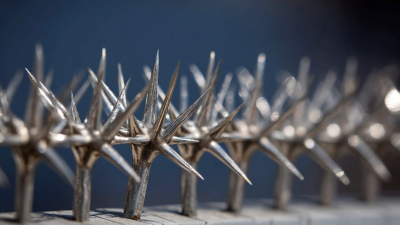
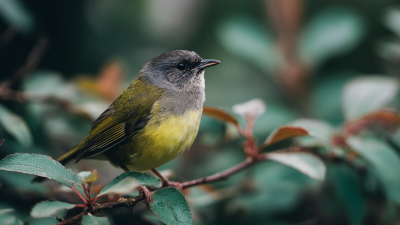
How to Choose the Best Bird Repellent Devices for Your Needs?
Birds can create serious challenges in various settings. From agricultural fields to urban environments, the presence of birds often leads to significant economic losses. According to a report from the USDA, bird-related damage costs U.S. farmers about $1 billion annually. Choosing the right Bird Repellent Devices is crucial for mitigating these impacts.
Expert Jim Toller, a leading figure in avian management, states, "Effective bird control starts with understanding the bird species and their behaviors." This insight emphasizes that selecting appropriate devices requires a tailored approach. Different species respond uniquely to deterrents, making it essential to assess specific needs before making a decision.
Not all Bird Repellent Devices are equally effective. Some may provide temporary solutions while others offer long-term results. Users often report mixed success, highlighting the need for careful consideration. Evaluating factors like the environment and bird behavior is key to effective bird management.

Understanding Bird Behavior and Common Species in Your Area
Understanding bird behavior is essential when selecting bird repellent devices. Different species have unique habits. For instance, pigeons often roost on urban buildings, while starlings prefer open fields. According to a study by the National Pest Management Association, over 60% of commercial properties face bird-related issues. Ignoring local species can lead to ineffective deterrent choices.
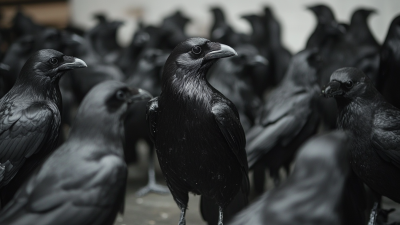
Common birds in urban areas can be particularly challenging. Sparrows and grackles are flock species. They adapt quickly to human environments. Data shows that these birds can cause significant property damage. A single flock may contain hundreds of individuals. This often requires a tailored approach to repellent devices. Many people underestimate this simple fact.
Birds are more active in different seasons. Understanding these patterns helps in choosing the right solution. Spring sees an increase in nesting behavior. This can lead to conflicts with property owners. Also, a report from the Environmental Protection Agency indicated that bird droppings contain harmful pathogens. Knowing when and where to apply repellent is crucial. Ignoring these factors may invite more problems than solutions.
Evaluating Different Types of Bird Repellent Devices Available
When considering bird repellent devices, it's essential to evaluate the various types available.
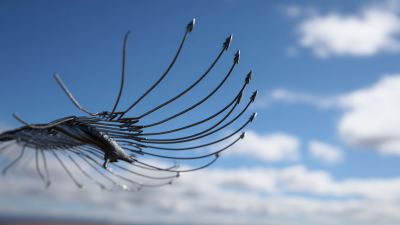
Visual deterrents, like reflective tape or predator decoys, can effectively scare birds away.
These options are simple and often low-cost. However, their effectiveness may diminish over time, requiring repositioning or replacement to maintain their impact.
Audio deterrents are another choice. Devices that emit distress calls can repel unwanted birds.
They might work initially, but birds often become accustomed to the sound.
Regularly changing the sounds or the location of the device could help maintain its utility.
Electronic devices provide a different approach. Many use ultrasonic sound waves that are inaudible to humans but irritating to birds.
These devices can be quite effective, but some users report mixed results. Environmental factors, like nearby trees or buildings, may dilute their efficacy.
Therefore, understanding your specific environment is crucial in selecting the right device.
Comparative Analysis of Efficacy: Visual, Auditory, and Taste Repellents
When selecting bird repellent devices, understanding their efficacy is crucial. Visual repellents, like reflective surfaces and decoys, can effectively deter birds. These devices exploit birds' natural instincts, making them perceive threats. However, their effectiveness can wane over time as birds grow accustomed to them. It’s important to periodically change the location or style of visual deterrents.
Auditory repellents utilize sound to ward off birds. Devices emit distress calls or predator noises, creating an uncomfortable environment for birds. While effective initially, these devices may lose their potency. Birds are intelligent creatures and may become desensitized to repetitive sounds. Thus, alternating sounds or employing various devices can help maintain their deterrent effects.
Taste repellents work differently. They involve substances that taste unpleasant to birds. Feasibility depends on proper application methods. However, ensuring coverage can be challenging. Birds require consistent exposure to these substances for maximum efficacy. In reality, combining different types of repellents can create a diverse approach, accommodating various bird species and behaviors. Each method has its pros and cons, and a little trial and error may be necessary to find the perfect fit for specific needs.
Factors Influencing the Effectiveness of Bird Repellent Devices
When selecting bird repellent devices, several factors influence their effectiveness. One critical aspect is the type of birds you want to deter. Different species respond to various stimuli. For instance, larger birds may be more affected by visual deterrents, while smaller birds might react better to sound devices. Thus, understanding your specific challenge is essential.
The environment is another key factor. Open spaces may require different solutions than urban settings. In quieter neighborhoods, sounds might carry further. Conversely, in busier areas, visual cues may work best. Also, consider how weather conditions affect device performance. Rain or wind can diminish the effectiveness of some devices.
Maintenance plays a role in ensuring ongoing effectiveness. Devices can become dirty or damaged over time. Regular checks are necessary to keep them functioning optimally. However, not everyone has the time for this, which can lead to ineffective results. Being mindful of these factors will help in making an informed decision.
Cost-Effectiveness and Maintenance Considerations for Bird Repellents
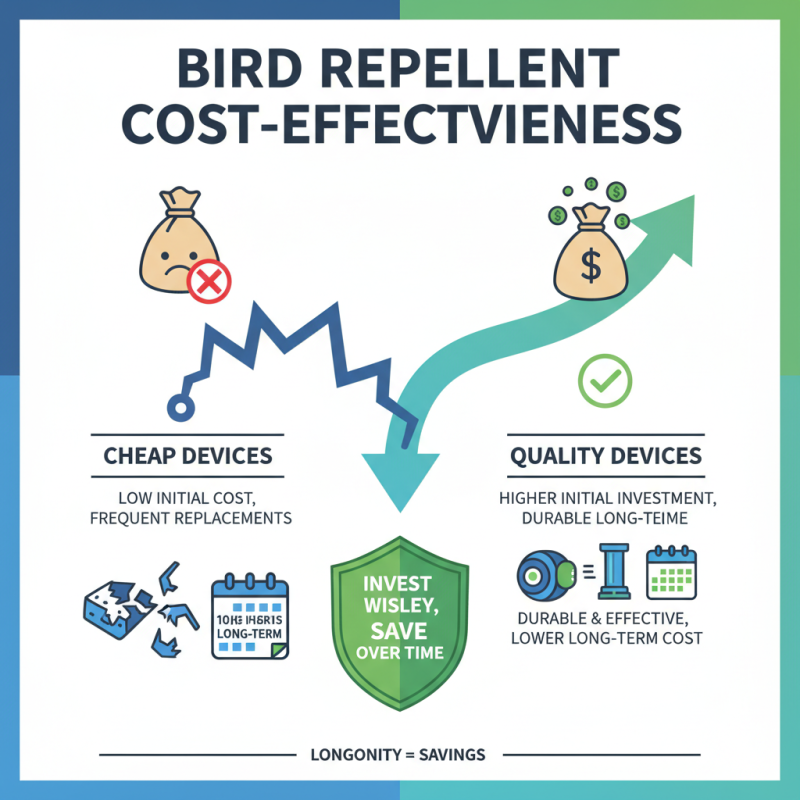
When choosing bird repellent devices, cost-effectiveness is crucial. Investing in a high-quality product can save money in the long run. Some devices may be cheap, but their effectiveness often falls short. You might end up replacing them frequently, which increases overall costs. Consider your budget and the longevity of the devices. A slightly higher initial investment can lead to fewer replacements.
Maintenance should also be a priority. Some bird repellent devices require regular upkeep. You may need to clean or reposition them often. This can be time-consuming. If you are busy, look for low-maintenance options. Devices that need little attention will be ideal for those with hectic schedules. Think about how much effort you are willing to commit over time.
Lastly, remember that not every solution works for every situation. Personal experiences may differ. Some might find success with visual repellents, while others prefer auditory ones. It’s worth experimenting but may involve some trial and error. Reflect on what has been effective in the past. Balancing cost and maintenance is key to finding what suits your specific needs best.



 Bird & Pigeon Pest Control
  Mice & Rat Pest Control
  Mole & Vole & Gopher Pest Control
  Fly Insect Pest Control
  Wasp & Bee Pest Control
  Moth Pest Control
  Mosquito Pest Control
  Cockroach Pest Control
  Wildlife Pest Control
  Snake Pest Control
  Bed Bug & Flea Pest Control
  Snail & Slug Pest Control
  Ant & Termites Pest Control
  Spider Pest Control
  Other Insect Pest Control
  Garden Products
  Blog
Blog  Dining Group
 Occasional Tables
 Barstool
 Company Profile
 Our Advantages
 Certification
 Factory VR
 Photos
 Videos
 Product News
 Industry News
 Media Live
 Our Services
 Distributor and Agent
 FAQs
FAQs